The end of Orban, the end of sovereigntism

Orbán has lost. And with him, symbolically and politically, an entire historical cycle loses as well: that of European sovereigntism, which for years has thrived by feeding on fear, division, and democratic regression.
For over sixteen years, Hungary has been the laboratory of the sovereigntist model: concentration of power, erosion of the rule of law, systematic infiltration of institutions — from universities to courts — and the construction of consensus based on fear.
Fear is the key value of sovereigntism, expressed in multiple and varied forms.
Fear of the immigrant, of the gay person, of the trans person.
Fear of the other.
Fear turned into a political tool.
The second defining value of sovereigntism is hypocrisy, also expressed in different ways.
It hypocritically presents itself as a defender of Christian values, only to reject those very values in its contempt for poverty and humanity.
It hypocritically presents itself as a defender of the nation, while in reality acting as a sycophant of the interests of Putin’s Russia and of the United States.
It must not be overlooked that, if Orbán’s Hungary has represented the heart of international sovereigntism, this phenomenon has found fertile ground thanks to broader international dynamics.
The United States — both under Democratic administrations and, even more explicitly, during the Trump era — has contributed directly to strengthening these tendencies.
The rise of a united and federal Europe, which is the very nightmare of sovereigntism, would represent a major blow to American imperialism and leadership.
A power of 500 million people, the world’s largest market, rich in history and tourism, with scientific leadership in numerous fields, endowed with an excellent and universally accessible healthcare system, as well as an educational system — less performant, but still broadly accessible — in stark contrast with the American privatized model, where access to healthcare and elite institutions increasingly remains the privilege of the wealthy.
For years, the United States has therefore supported — directly or indirectly — sovereigntist projects in Europe, particularly through Trump and his loyal ally Bannon, because, as the Romans already said, the best way to ensure a weak and subordinate Europe is divide et impera.
It is no coincidence that Trump and his vice president openly supported Orbán during the electoral campaign, as did Meloni.
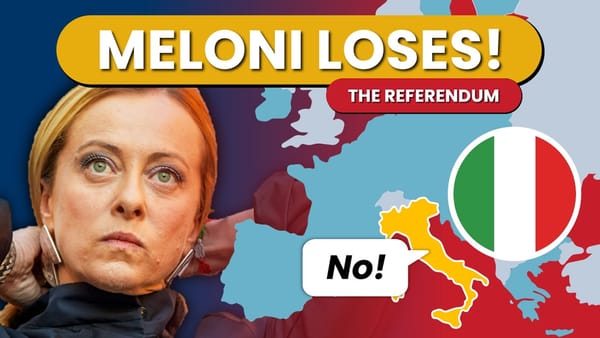
This defeat therefore marks a reversal of the sovereigntist trend, which until recently seemed to be on the rise everywhere, also in line with Meloni’s defeat in the referendum in March.
The reason for this decline is clear. The policies of Orbán, Meloni, and Trump have not truly improved the lives of citizens.
Contempt for the most vulnerable social classes, rising cost of living benefiting ever higher incomes for the super-rich, international tensions triggered by political whims such as tariff policies and Trump’s senseless war against Iran, which is pushing the entire world toward economic and energy collapse.
Sovereigntism does not respond — and cannot respond — to the real needs of people. It speaks to the gut and to fear. It is a failure because it offers simple answers to complex problems. And ultimately, it serves only to protect the interests of the elites.
Finally, another important factor has contributed to Orbán’s defeat: generations often underestimated and disparaged. Millennials and Gen Z voted massively against Orbán. This is not a detail, but a structural signal. New generations, also thanks to programs such as Erasmus, feel increasingly European and integrated.
In this sense, Orbán’s defeat is not just an electoral defeat, but a cultural signal that may contain the seed of a new cycle of values.