Why Meloni Lost the 2026 Referendum
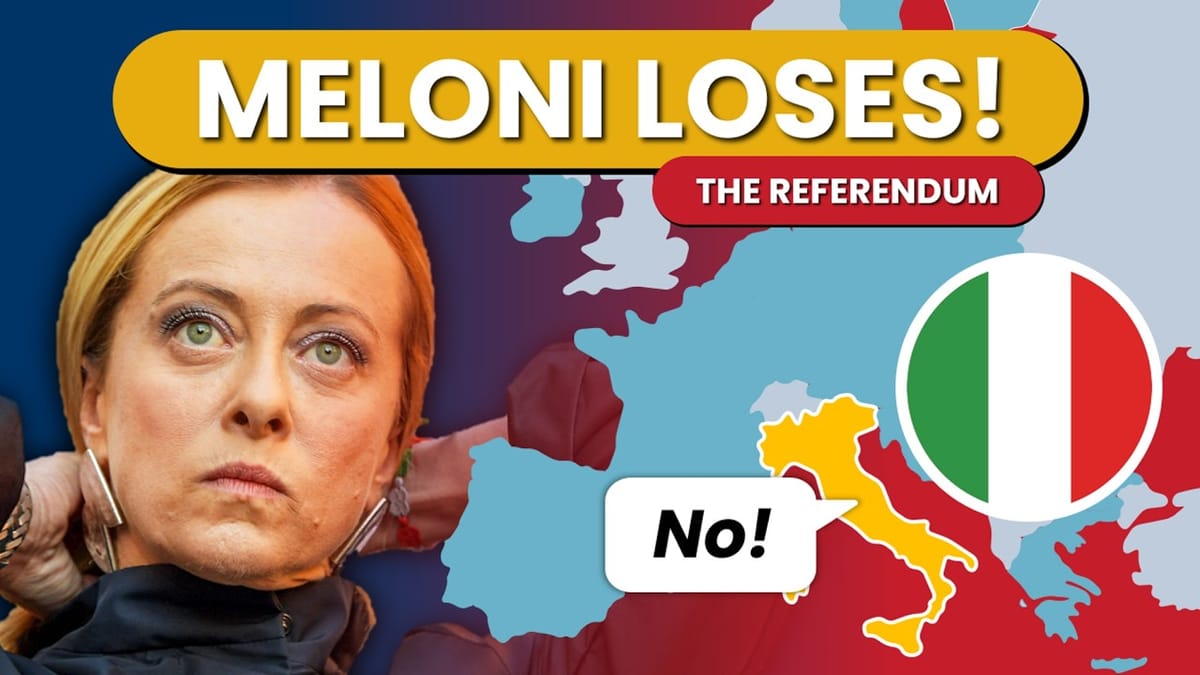
The defeat in the justice referendum of March 23, 2026 marked a turning point in Giorgia Meloni’s political ascent in Italy.
More than a simple electoral setback, this result appears to signal a fracture in the perception of strength and continuity that had characterized her leadership up to that point.
The vote cannot be interpreted solely in technical or contingent terms.
Rather, it reflects deeper dynamics — psychological, symbolic, and political — that have gradually accumulated over time.
In this article, we will attempt to identify some of the main causes of this defeat.
1. The homeostatic principle: the defense of the status quo
One of the reasons for Meloni’s defeat lies in a recurring principle in Italian political history:
the tendency to complain that things do not work, only to want to keep everything as it is when an external threat challenges the existing balance.
This is a psychologically understandable mechanism, somewhere between critical moralism and a deep attachment to the present state of affairs. On the one hand, there is a constant drive to criticize: the system that does not work and for institutions that are ineffective. But, when change becomes concrete, the opposite dynamic emerges: the defense of the existing balance, even if imperfect.
This phenomenon can be understood as a form of collective homeostasis:
the social system tends to preserve itself, including through electoral behavior.
In this sense, the “No” vote does not represent an active endorsement of the status quo, but rather a defensive reaction to a change perceived as uncertain or potentially detrimental.
Faced with a choice between an unsatisfactory but familiar equilibrium and an uncertain change, many individuals choose the former.
2. The archetypal transition: The rebel, the queen and the servant
For many years, during opposition, Meloni embodied the archetype of the Rebel, with succes.
A figure who opposes the system, exposes its contradictions, and presents herself as a radical alternative. This archetype had strong mobilizing power and contributed decisively to her electoral victory.
During the transition from opposition to institutional responsibility as a Prime Minister, a symbolic transformation was inevitable: Meloni progressively adopted traits closer to the archetypes of the Hero and the Queen, mixing them quite effectively, while never losing completely traits of the Rebel that led her to victory.
Following the latest developments in American politics, and in particular the electoral victory of Donald Trump, Meloni positioned herself as the leader of what she presented as the most stable and cohesive democratic government in Europe.
In line with a sovereignist political orientation, she chose to align herself with Trump, seeking not only a political convergence but also a strategic role: to present herself as a central pillar of the Atlantic alliance, acting as a key intermediary between European Union policies — as reflected in her relations with Ursula von der Leyen — and the United States.
In this framework, Meloni aimed to become a European reference point for the American political establishment, reinforcing her image as a leader capable of operating on an international stage.
However, it is precisely this alignment that, over time, contributed to the erosion of her symbolic and archetypal model.
As previously discussed, her political strength was rooted in the coherence of her archetypal positioning — first as a rebel, then as a sovereign figure embodying autonomy and authority. Yet, the growing perception of political subordination to Trump introduced a fundamental dissonance.
This shift has progressively weakened the archetypal structure that had sustained her leadership, transforming a figure once perceived as independent and assertive into one increasingly seen as subordinate and servile.
3. Symbolic rupture and material context
Trump’s recent policies toward traditional allies of the United States have exposed the limits — and, in part, the naïve assumptions — of a sovereignist strategy based on personal alignment.
The issue of trade tariffs, particularly relevant for Italy given the importance of Made in Italy exports to the U.S. market, illustrates this clearly.
The idea that political proximity to Trump could allowed Italy to bypass such measures now appears, at best, overly optimistic.
At the same time, the escalation of the war with Iran has further revealed the fragility of this strategic positioning.
The United States and Israel launched a series of strikes that triggered a broader regional conflict, without real prior coordination with European allies, creating tensions within NATO and across the Atlantic alliance.
In this context, Meloni’s alignment with Trump appeared increasingly problematic. The expectation of a privileged relationship — one that would grant influence, protection, or strategic advantage — was confronted with a different reality:
a geopolitical agenda driven primarily by U.S. interests, often indifferent to European constraints or priorities.
Meloni’s choice to closely align with Trump has progressively weakened her political positioning, and rather than reinforcing sovereignty, it has often created the perception of dependence.
As discussed earlier, Meloni’s strength relied on a coherent archetypal structure — first as a rebel, then as a sovereign figure capable of exercising authority.
However, the growing impression that she was unable to influence or counterbalance key international decisions introduced a clear dissonance.
In a country as Italy where economic inequality is increasing and social tensions remain significant, political miscalculations are felt more directly.
Within this framework, the referendum result can also be interpreted as the expression of a broader loss of confidence — not only in specific policies, but in the overall strategic direction.
